
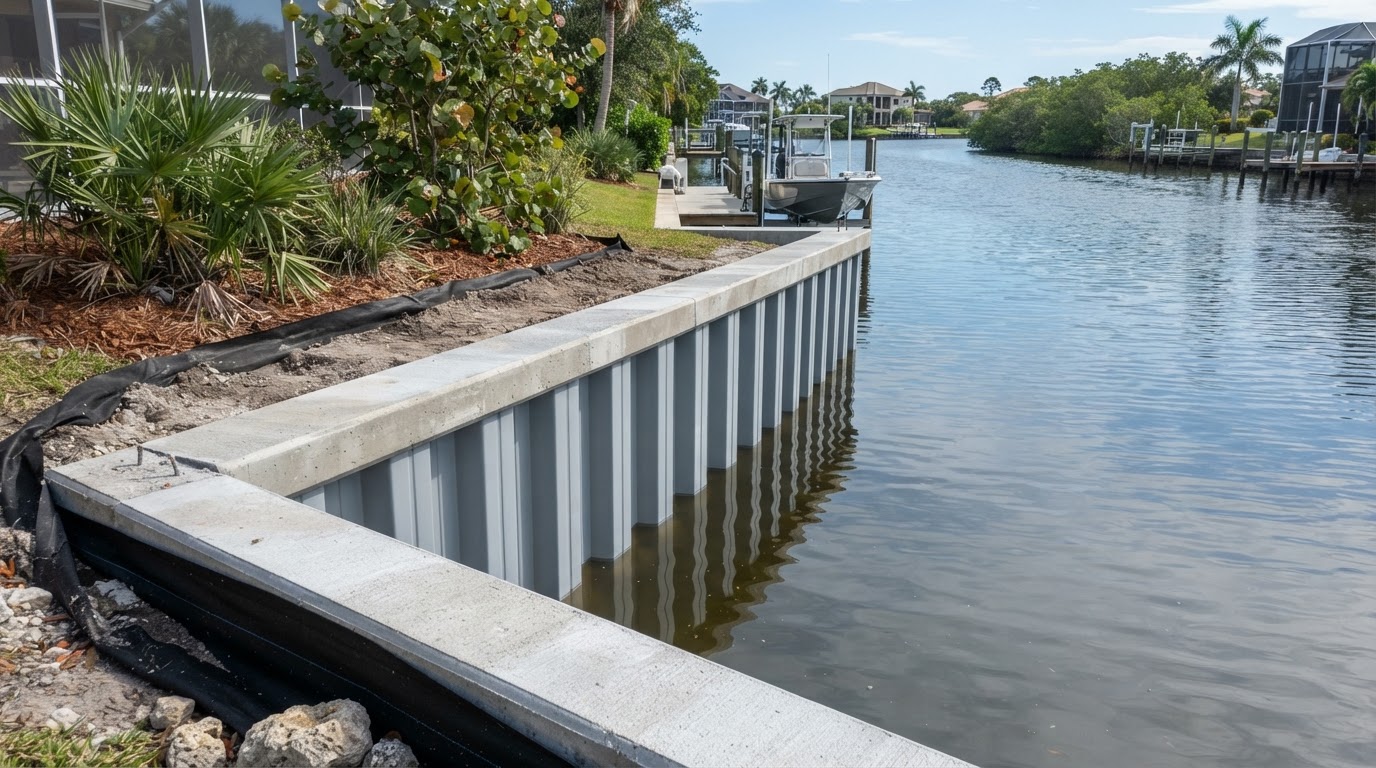
Vinyl Seawall Builders & Installation Daytona Beach
Vinyl sheet-pile seawalls are a common shoreline retaining option for Daytona Beach waterfront properties. This page explains how vinyl seawall systems work, where they may be appropriate, and how vinyl compares with concrete — without claiming one material is universally better.
Request a Marine Construction Estimate
Share your dock, seawall, or boat lift project details and we'll review the requirements for your Daytona Beach area waterfront property.
Vinyl Seawall Construction in Daytona Beach
A vinyl seawall is built from interlocking vinyl sheet piles driven vertically into the shoreline to retain upland soil and resist the forces acting on the waterfront. Along Daytona Beach canals and Intracoastal waterways, vinyl systems are common for residential applications where moderate wall heights and suitable soil conditions apply.
The vinyl panels are only one part of a complete structural system. A vinyl seawall also includes a cap, tieback anchoring, drainage to relieve hydrostatic pressure, and engineered backfill. Each component is sized for the specific site — the panels alone do not constitute a complete wall.
- Vinyl sheet-pile panels and interlocking design
- Caps, tiebacks, and anchoring components
- Drainage and engineered backfill
- Shoreline configuration and water depth
- Engineering design and environmental review
How Vinyl Seawall Systems Work
A vinyl seawall relies on interlocking sheet-pile panels driven into the shoreline to form a continuous vertical wall. The panels resist lateral soil pressure, while a cap ties the top of the wall together and protects the panel edges. Tiebacks and anchors extend landward into the soil to hold the wall against the forces pushing outward.
Drainage behind the wall relieves hydrostatic pressure that builds as water accumulates in the backfill. Without proper drainage, water pressure can stress even a well-built wall. Backfill material, connection details, and the engineered design complete the system — no single component performs alone.
- Sheet-pile panels form the vertical wall
- Caps protect panel tops and tie the wall together
- Tiebacks and anchors resist lateral soil pressure
- Drainage relieves hydrostatic pressure behind the wall
- Engineered backfill completes the structural system
Vinyl Seawall Applications Near Daytona Beach
Suitability depends on site-specific conditions rather than a universal rule. No vinyl system is appropriate for every waterfront.
- Shoreline configuration and wall height
- Water depth and tidal range at the location
- Soil conditions and geotechnical considerations
- Site access for equipment and materials
- Existing structures and utility locations
- Engineering design for the specific site
- Environmental review based on waterbody and jurisdiction
Vinyl vs. Concrete Seawalls in Daytona Beach
Vinyl and concrete suit different conditions. A balanced comparison considers installation, maintenance, and site compatibility — neither is universally cheaper or stronger.
Vinyl Seawalls
- Corrosion-resistant in salt and brackish water
- Common for moderate residential wall heights
- Installation considerations differ from concrete
- Maintenance focuses on caps, anchors, and drainage
Concrete Seawalls
- Heavy-duty capacity for higher-load sites
- Reinforced for engineered wave and soil forces
- Different construction access requirements
- Maintenance focuses on cracking, spalling, and caps
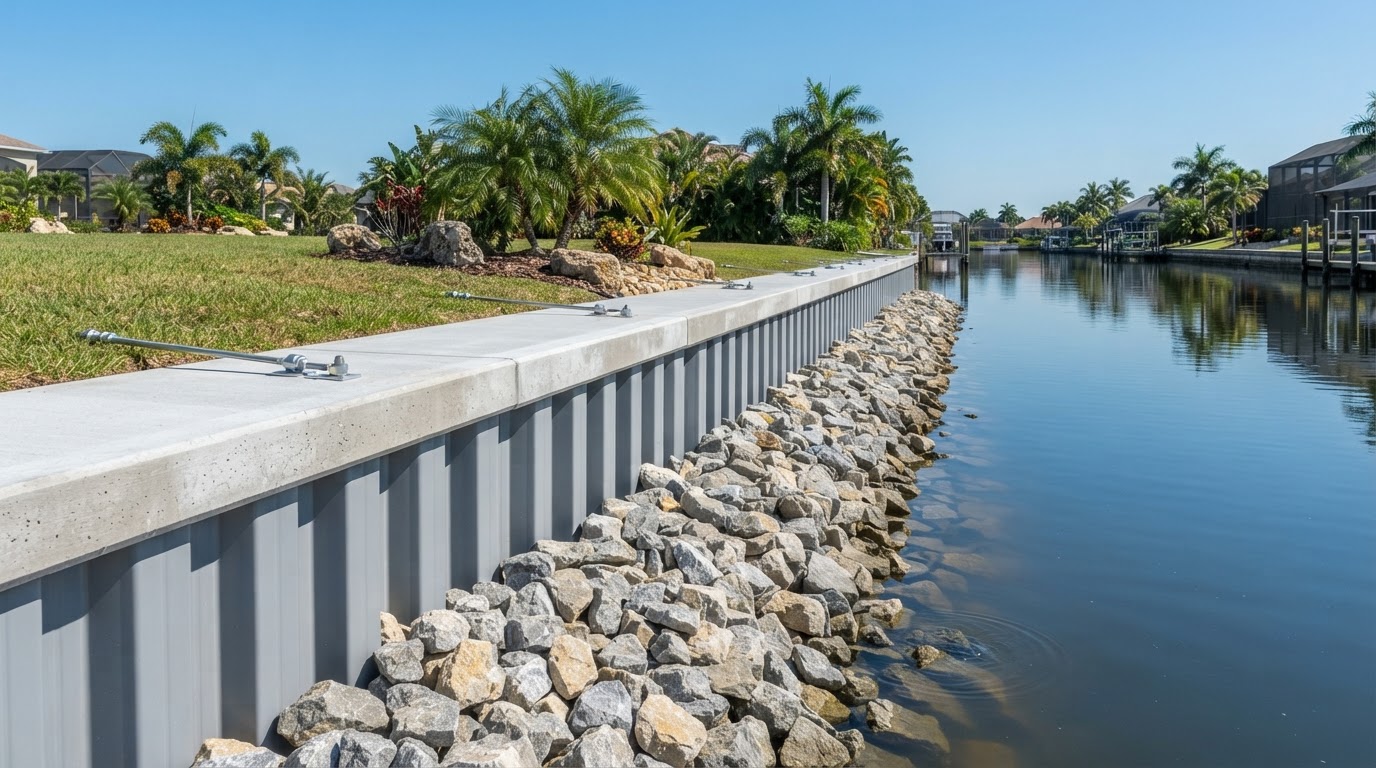
Vinyl Seawall Replacement & Upgrades
An existing seawall may be evaluated for replacement with a vinyl system when the original wall has reached the end of its service life or no longer performs as intended. Replacement planning considers the existing footprint, adjacent improvements, shoreline conditions, and whether the new wall will be built within the existing footprint or expanded.
Compatibility with existing docks, lifts, and shoreline improvements matters — a new wall interacts with the structures around it. No vinyl system is automatically approved for every replacement; the appropriate approach depends on the site and engineering.
- Existing wall condition and footprint
- Adjacent docks, lifts, and improvements
- Shoreline conditions and water depth
- Engineering design and material selection
- Potential environmental review
Maintaining Vinyl Seawalls Near Daytona Beach
Vinyl seawall maintenance generally involves periodic inspection of the cap, wall panels, tiebacks, drainage, and the soil behind the wall. Watching for movement, cracking, soil loss, or drainage problems helps catch issues early. Structural repairs should be referred to qualified professionals rather than attempted without assessment — no universal maintenance interval applies.
Related Services Near Daytona Beach
Explore other marine construction topics relevant to your waterfront project.