
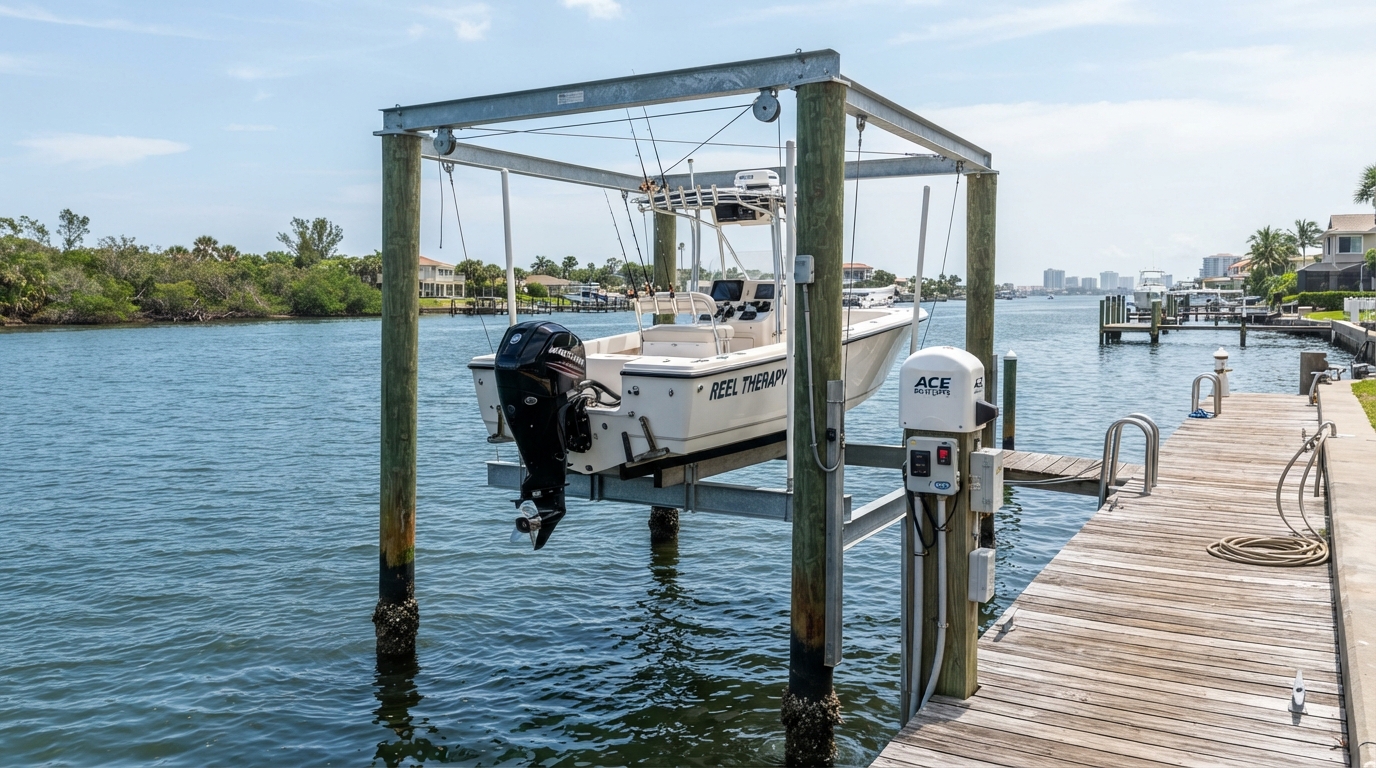
Boat Lift Builders & Installation Daytona Beach
A boat lift raises a vessel out of the water to protect the hull from saltwater, marine growth, and storm surge. This page explains the boat lift systems available to Daytona Beach waterfront property owners, the factors that shape lift selection, and the considerations involved in installing a lift on an existing or new dock.
Request a Marine Construction Estimate
Share your dock, seawall, or boat lift project details and we'll review the requirements for your Daytona Beach area waterfront property.
Boat Lift Builders & Installation in Daytona Beach
A boat lift is a mechanical system that raises a vessel above the water for storage, protecting the hull from continuous saltwater exposure, marine growth, and tidal or storm surge. Along Daytona Beach waterways, lifts are commonly installed on private docks for residential vessels ranging from center consoles to larger cabin boats.
Selecting and installing a boat lift depends on the vessel's weight, length, and beam, the dock's structural capacity, water depth, water-level changes, and electrical access. No universal lift capacity or installation method is appropriate for every property — lift selection and safe installation depend on qualified assessment and manufacturer documentation.
- Vessel weight, length, and beam
- Dock structural capacity and piling placement
- Water depth and water-level changes
- Electrical access for motors and controls
- Manufacturer specifications and qualified design
Boat Lift Systems for Daytona Beach Waterfront Properties
Several boat lift configurations are available, each suited to different vessel sizes, dock types, and water conditions. Not every configuration suits every site.
Cradle-Style Lifts
Cradle lifts support the vessel on adjustable bunks suspended from cables, suiting a range of hull shapes and vessel weights where dock structure and water depth allow.
Four-Post Lift Systems
Four-post lifts mount on pilings and distribute the vessel's weight across multiple support points, suited to vessels where the dock structure can carry the load.
Elevator-Style Configurations
Elevator lifts raise the vessel on a platform, sometimes suited to deeper water or specific dock configurations where a manufacturer-supported design applies.
PWC & Personal Watercraft Lifts
Smaller lift systems raise personal watercraft and Jet Skis out of the water, sized to the watercraft's dimensions and weight for protected storage.
Choosing a Boat Lift Near Daytona Beach
Several factors shape which lift is appropriate for a given vessel and dock. No specific capacity should be recommended without verified vessel information and qualified design.
- Vessel weight — the lift must be rated for the loaded vessel
- Vessel length and beam for bunk and cradle sizing
- Hull configuration — single, twin, or flat-bottomed
- Manufacturer specifications for the selected system
- Dock structure and piling capacity to carry the load
- Water depth and water-level changes at the location
- Electrical access for motors and control systems
Installing a Boat Lift on an Existing Dock
In many cases a boat lift can be added to an existing dock, but it depends on the dock's structural capacity, piling placement, water depth, and the vessel's size and weight. The existing pilings and framing must be evaluated to determine whether they can support the lift's loaded weight or whether reinforcement is needed.
A qualified assessment and manufacturer documentation determine whether the existing dock can support the lift or whether structural upgrades are required. No universal installation method applies to every dock — the appropriate approach depends on the specific structure, vessel, and site conditions.
- Evaluate existing piling capacity and placement
- Assess dock framing and structural connections
- Confirm water depth for the lift's operating range
- Verify electrical access for motors and controls
- Reinforce the dock where the existing structure requires it
- Use manufacturer documentation for the selected system
Boat Lift Installation & Waterfront Access
Access, site constraints, and vessel maneuvering can all influence how a lift is installed and whether a given configuration is practical.
- Waterfront access for equipment and materials during installation
- Site constraints such as narrow canals or tight slips
- Vessel maneuvering room for loading and launching
- Water-level changes that affect lift operation
- Proximity to shore power and control wiring
- Neighboring docks and shared waterfront considerations
Boat Lift Materials, Motors & Components
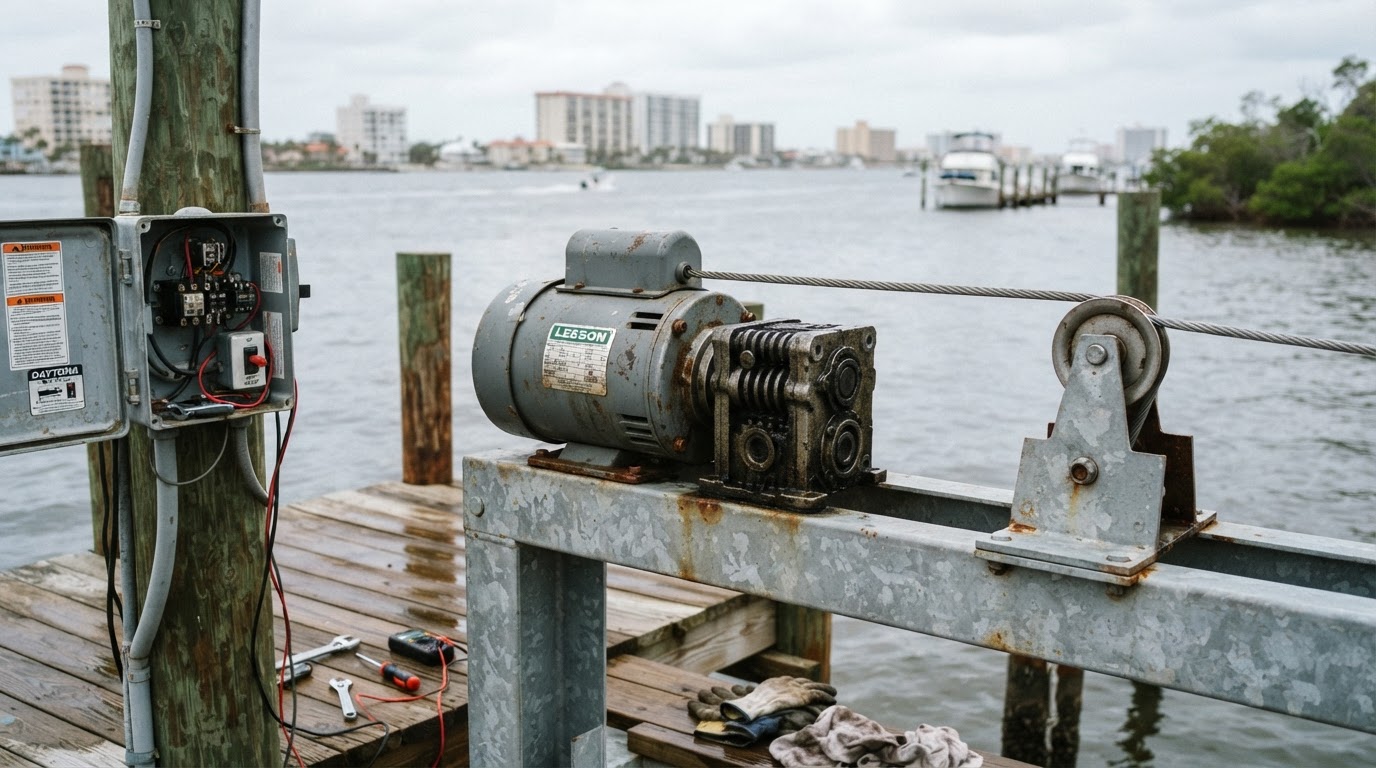
A boat lift is an assembly of structural and mechanical components: the frame or cradle, bunks that support the hull, cables or lifting media, a motor and gearbox, controls, and mounting hardware. In a salt or brackish water environment, corrosion-resistant materials and hardware matter for long-term performance.
Motors and electrical components near water require qualified installation. No unsupported lifespan or safety guarantee applies to lift equipment — performance depends on usage, exposure, maintenance, and manufacturer specifications. Component selection should follow manufacturer documentation and qualified design.
- Structural frames and cradles sized to the vessel
- Bunks that cradle and protect the hull
- Cables or lifting media rated for the load
- Motors, gearboxes, and control systems
- Mounting hardware and corrosion-resistant fasteners
Boat Lift Maintenance Near Daytona Beach
Boat lift maintenance involves periodic inspection of cables, motors, cradles, and hardware for wear, corrosion, and alignment. Component wear and corrosion should be addressed by qualified servicing — damaged or unstable systems should not continue operating until properly assessed. No universal servicing interval applies; maintenance needs depend on usage, exposure, and manufacturer guidance.
Related Services Near Daytona Beach
Explore other marine construction topics relevant to your waterfront project.