
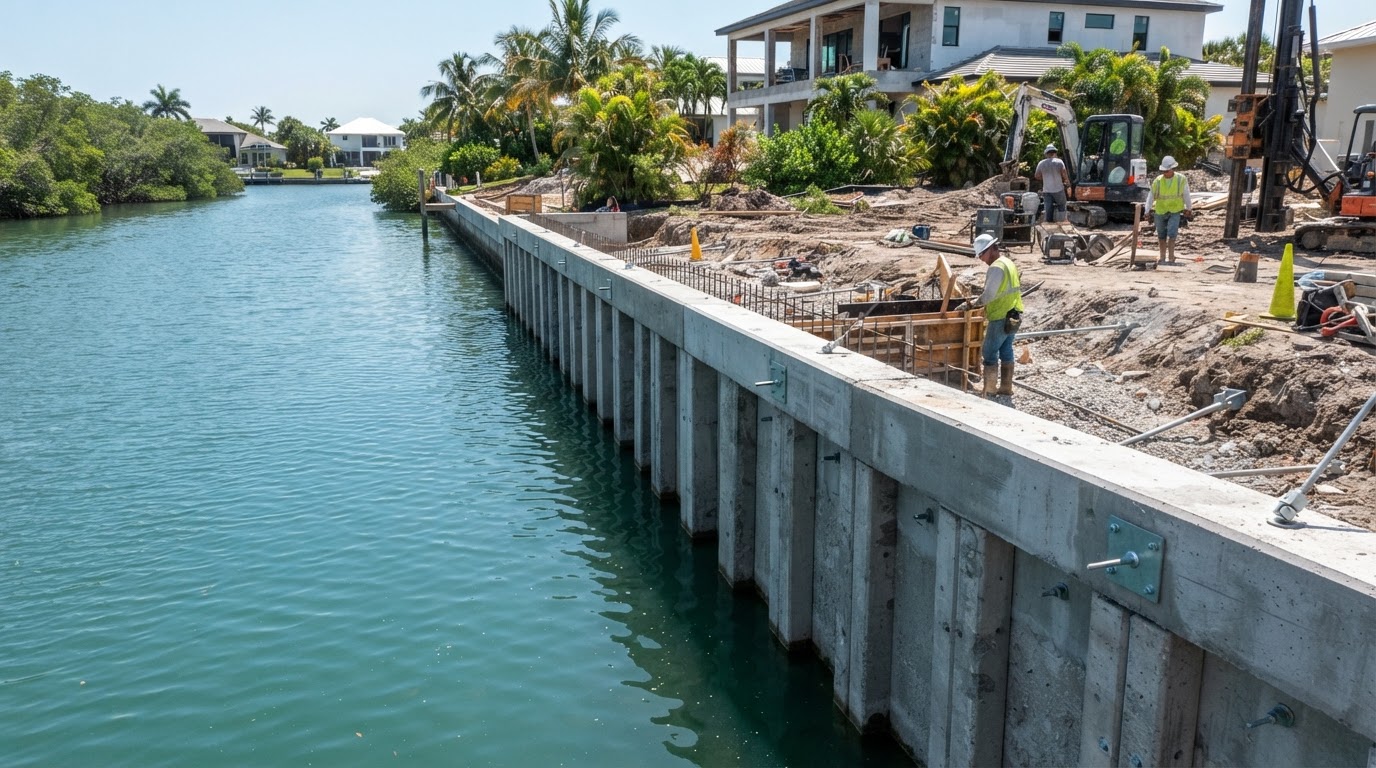
Seawall Replacement & Installation Daytona Beach
When a seawall reaches the end of its service life or suffers widespread deterioration, replacement may be the appropriate path. This page explains how seawall replacement is evaluated, what materials are available, and how rebuilding differs from localized repair.
Request a Marine Construction Estimate
Share your dock, seawall, or boat lift project details and we'll review the requirements for your Daytona Beach area waterfront property.
Seawall Replacement & Installation in Daytona Beach
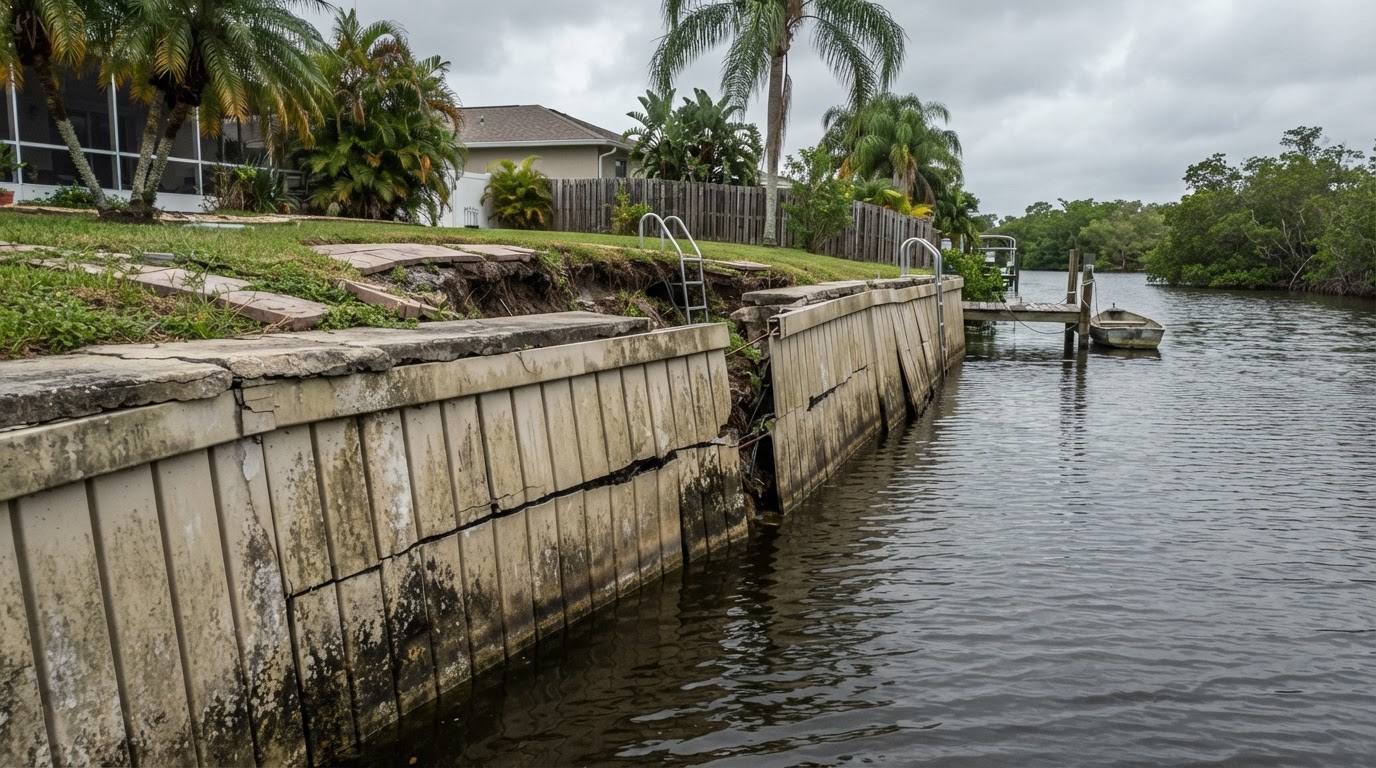
An existing seawall may require replacement evaluation when deterioration is widespread, structural movement is significant, or repeated repairs no longer hold. Replacement involves removing the failing wall and rebuilding a new engineered system — a distinct undertaking from targeted repair of individual defects.
Replacement is a major waterfront investment, so understanding the evaluation process, material options, and site considerations helps property owners prepare. No single symptom automatically requires full replacement; a qualified inspection determines whether repair is feasible or replacement is appropriate.
- Widespread structural deterioration
- Significant wall movement or leaning
- Repeated failures and recurring repairs
- Extensive soil loss or compromised anchoring
- End-of-service-life wall materials
Signs a Seawall May Need Replacement Near Daytona Beach
These conditions may warrant replacement evaluation. No single symptom automatically requires full replacement — a qualified inspection determines the appropriate path.
- Significant structural movement or leaning
- Extensive deterioration across the wall
- Repeated failures or recurring repairs
- Widespread wall defects and panel damage
- Major soil loss behind the wall
- Compromised supporting systems and anchoring
Evaluating an Existing Seawall Before Replacement
Before replacement, the existing wall is evaluated to understand its condition and the factors driving failure. This includes assessing the wall material, structural movement, soil conditions, property access, adjacent improvements, and shoreline conditions.
Engineering considerations and potential environmental constraints also factor into the evaluation. The goal is to determine whether replacement is necessary and, if so, to design a new wall suited to the specific site rather than simply replicating the failed structure.
- Existing wall condition and material
- Structural assessment of movement and deterioration
- Property access for demolition and construction
- Adjacent improvements and utilities
- Shoreline conditions and water depth
- Engineering considerations for the new design
- Potential environmental constraints and permitting
Seawall Replacement Materials in Daytona Beach
Vinyl and concrete are the primary replacement options, each with distinct considerations. Neither is universally better — the choice depends on the site.
Vinyl Replacement
- Corrosion-resistant in salt and brackish water
- Common for residential canal and Intracoastal walls
- Suited to moderate wall heights and soil conditions
- Interlocking sheet-pile installation
Concrete Replacement
- Heavy-duty reinforced construction
- Suited to higher-load and more exposed sites
- Engineered for specific wave and soil conditions
- Cast or poured concrete bulkhead systems
Existing Footprint Replacement vs. Expanded Construction
Rebuilding within an existing footprint and expanding a wall may involve different review requirements. No permit exemptions should be assumed.
- Rebuilding within the existing footprint may simplify some reviews
- Expanding or reconfiguring a wall may trigger additional review
- An exemption from one requirement does not establish approval from others
- Permit applicability depends on location, scope, and waterbody
- No universal permit exemptions apply to replacement projects
- Project-specific determinations should be referred to the appropriate authority
Demolition, Access & Site Preparation Considerations
Replacing a seawall involves removing the existing structure and preparing the site for the new wall.
Removal & Disposal
Removing existing wall materials, caps, and compromised components, with proper disposal of demolition debris from the waterfront site.
Excavation & Access
Excavation behind the wall for tieback installation and backfill, with equipment access coordinated to the property's shoreline constraints.
Barge Mobilization
Where land access is limited, barge mobilization may be required to deliver equipment and materials to the waterfront work area.
Replacement vs. Structural Repair
Whether a wall needs replacement or can be addressed with structural repair depends on the extent and cause of deterioration. This is a property-specific determination that should be made by qualified professionals after inspection — not assumed from general guidance or a single visible symptom.
Related Services Near Daytona Beach
Explore other marine construction topics relevant to your waterfront project.