
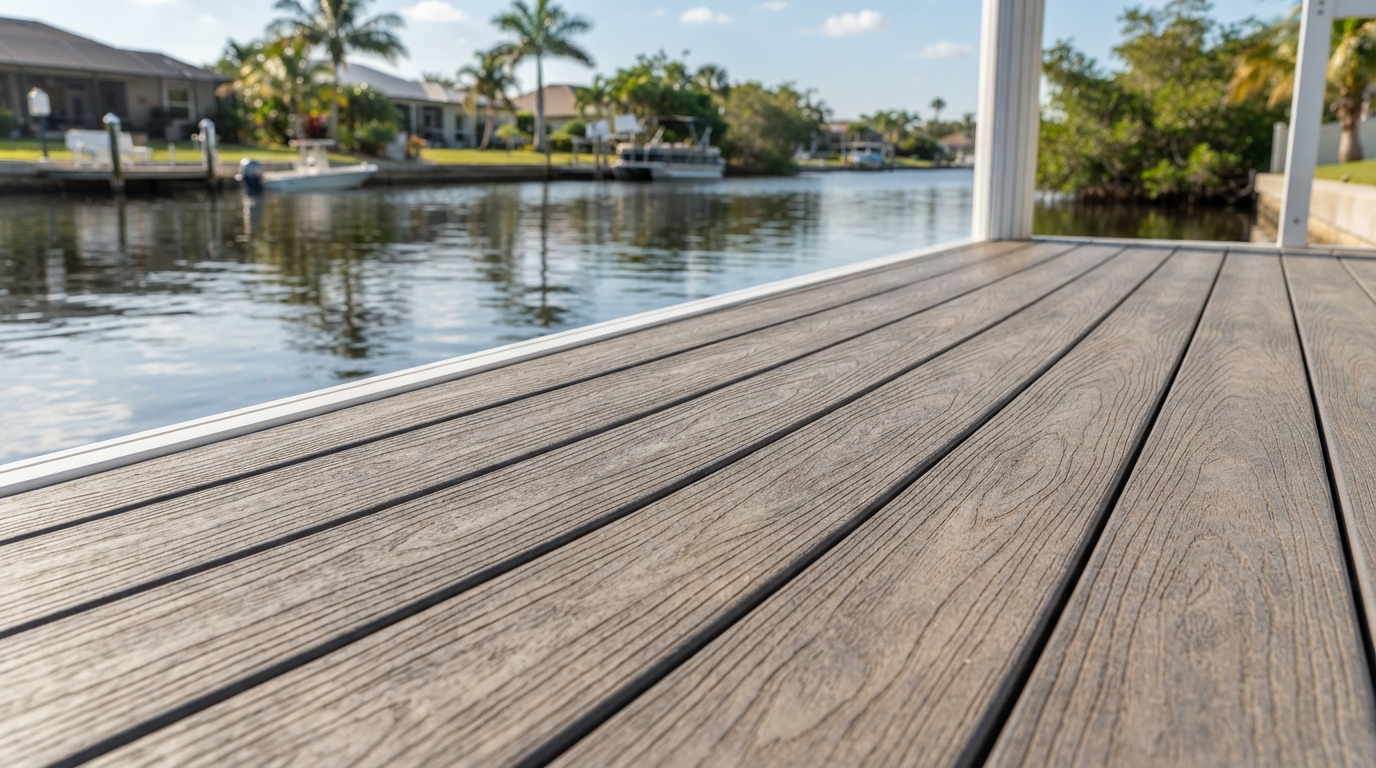
Composite Dock Decking Installation Daytona Beach
Composite dock decking is a low-maintenance alternative to wood for the walking surface of a marine dock. This page explains composite decking options, how it compares with wood, and the considerations for installing composite on a Daytona Beach waterfront dock.
Request a Marine Construction Estimate
Share your dock, seawall, or boat lift project details and we'll review the requirements for your Daytona Beach area waterfront property.
Composite Dock Decking Installation in Daytona Beach
Composite decking is made from a blend of materials engineered to resist rot, splintering, and the effects of moisture and sun. On a marine dock, composite boards form the walking surface over the structural framing. Along Daytona Beach waterways, composite decking suits owners who want a lower-maintenance surface than wood on a fixed or floating dock.
Composite decking is a surface material — it is not a structural system on its own. The framing, pilings, and connections beneath must be appropriate for the dock's loads and the composite product's requirements. Not every composite material is approved for every dock application, and product specifications and manufacturer requirements should guide selection.
- Composite boards as a low-maintenance walking surface
- Framing and fastening system compatibility
- Product specifications and manufacturer requirements
- Comparison with wood decking
- Fixed and floating dock applications
Composite Decking Options for Waterfront Docks
Composite dock decking options vary in board construction, surface characteristics, framing compatibility, and fastening systems. Some products use hidden fasteners for a clean surface; others use face-fastened boards. Surface texture affects slip characteristics and surface temperature in sun, and product specifications determine spacing, span, and support requirements.
Manufacturer requirements guide how a product is installed — joist spacing, fastener type, expansion gaps, and edge detailing all matter. A product suited to a residential deck on land may not be appropriate for a marine dock exposed to water and salt air. Not every composite material is approved for every dock application.
- Board construction and surface characteristics
- Framing and joist compatibility
- Fastening systems and hidden fasteners
- Product specifications and span requirements
- Manufacturer installation requirements
Composite vs. Wood Dock Decking Near Daytona Beach
Composite and wood decking each have different appearance, maintenance, and performance characteristics. Neither is universally better — the choice depends on the site and owner preferences.
Composite Decking
- Resists rot, splintering, and moisture
- Generally lower maintenance than wood
- Surface temperature and slip characteristics vary
- Requires compatible framing and fasteners
Wood Decking
- Traditional appearance and feel
- Proven marine performance with maintenance
- Periodic sealing or treatment needed
- Familiar installation and repair
Replacing Existing Dock Boards with Composite
Replacing wood boards with composite requires evaluating the underlying framing, connections, and structural compatibility — not just swapping the surface.
- Framing condition and joist spacing for the product
- Connection and fastener compatibility
- Structural integrity of the dock beneath
- Span and support requirements of the composite
- Expansion gaps and edge detailing
Composite Decking for Fixed & Floating Docks
Composite decking can be used on both fixed and floating docks, but suitability depends on the structural system and the product's requirements.
Fixed Docks
On a pile-supported fixed dock, composite boards span the structural framing. Joist spacing and fastening must meet the product's requirements for the dock's exposure and use.
Floating Docks
On a floating dock, composite decking must suit the platform's framing and movement with the water. Weight and fastening considerations differ from a fixed structure.
Marine Exposure & Decking Maintenance
Composite decking generally needs less upkeep than wood, but marine exposure still requires cleaning, inspection, and attention to fasteners and wear.
- Periodic cleaning of the deck surface
- Inspection of boards for wear or damage
- Checking fasteners for looseness or corrosion
- Monitoring framing and connections beneath
- Attention to environmental exposure over time
Planning a Dock Decking Upgrade in Daytona Beach
A decking upgrade involves project measurements, material selection, and the condition of existing framing and connections. The right product depends on the dock type, exposure, and intended use, and manufacturer requirements should guide installation. Project-specific determinations should be referred to qualified professionals rather than assumed from general guidance.
Related Services Near Daytona Beach
Explore other marine construction topics relevant to your waterfront project.