
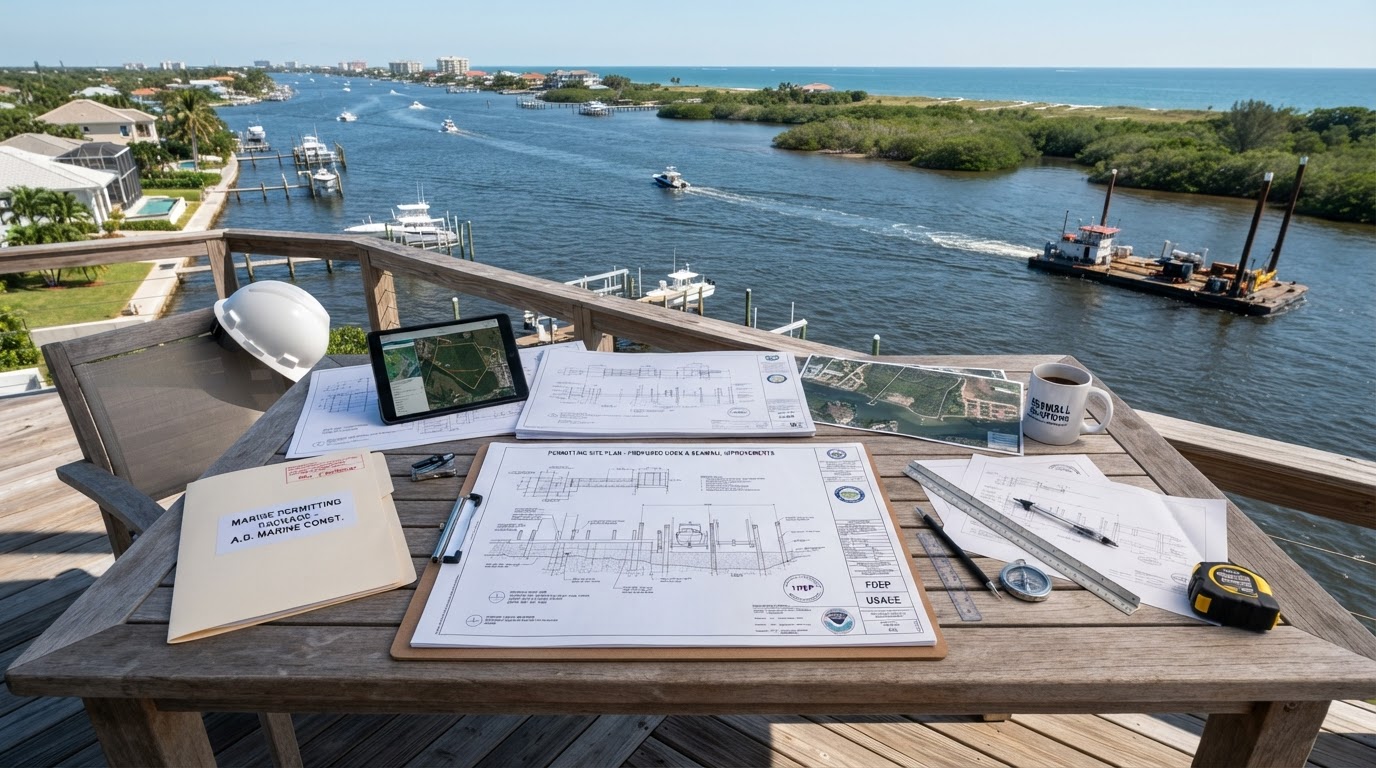
Sovereign Submerged Lands Leases & Consent Daytona Beach
Owning waterfront upland property and holding an environmental permit are not the same as having authorization to use the submerged lands below the water. This guide explains the distinction between regulatory permission and proprietary authorization for sovereign submerged lands near Daytona Beach — without claiming every underwater parcel is state-owned, that every dock needs a lease, or that a homeowner automatically owns the water bottom.
Request a Marine Construction Estimate
Share your dock, seawall, or boat lift project details and we'll review the requirements for your Daytona Beach area waterfront property.
Sovereign Submerged Lands Near Daytona Beach
Sovereign submerged lands are certain water-bottom areas held in trust by the state. Using those lands for a dock, seawall, or other structure may require a proprietary authorization — such as consent or a lease — that is separate from environmental permitting and from local building approval. This is a distinct question from whether a project meets environmental standards.
This page is general educational guidance, not a legal determination of title or riparian rights. Specific ownership and authorization questions should be verified with the applicable state authority and qualified professionals. This site does not provide legal conclusions about property boundaries or state title.
- Upland ownership versus water-bottom ownership
- Regulatory permits versus proprietary authorization
- Consent, leases, and other authorization types
- Why dock type and facility use matter
- Why a permit does not convey ownership
- Where to verify submerged-land status
What Are State-Owned Submerged Lands?
Certain submerged lands are held by the state in trust for the public. A dock, seawall, or other structure that occupies those lands may require a proprietary authorization from the state in addition to any environmental or local approvals. Owning the upland waterfront parcel does not automatically mean you own the water bottom adjacent to it, and an environmental permit does not, by itself, convey the right to use state-owned submerged lands.
This page does not claim that every underwater parcel is state-owned, or that every dock requires a submerged-land lease. Whether a specific project requires proprietary authorization depends on the land title, the project type, the facility use, and current agency review.
- Certain submerged lands are held by the state in trust
- Upland ownership does not automatically include the water bottom
- An environmental permit does not convey submerged-land rights
- Whether authorization is required depends on title, project, and use
Regulatory Permits Versus Property Authorization
A permit that allows construction and a proprietary authorization to use state land are separate questions.
Regulatory Permit
- Addresses environmental impacts and construction standards
- An ERP exemption or permit is a regulatory determination
- Does not convey rights to occupy state-owned submerged lands
- Issued under environmental and construction authority
Proprietary Authorization
- Addresses the right to use state-owned submerged lands
- May take the form of consent, a lease, or another instrument
- Is separate from environmental permitting
- Depends on land title, project type, and facility use
Consent, Leases and Other Authorization Questions
Where proprietary authorization is required, the form it takes can vary. Consent may apply to certain types of use; a lease may apply to others. The appropriate instrument depends on the project type, the facility use, the duration of the use, and current state requirements. This page does not prescribe which instrument applies to a specific project, and does not imply that one form is automatically simpler or less expensive than another.
Whether authorization is needed at all, and in what form, is a determination made by the applicable state authority for the specific parcel and activity. This page refers those determinations to the responsible authority and qualified professionals.
- Consent, leases, and other instruments serve different uses
- The appropriate form depends on project type and facility use
- No form is automatically simpler or less expensive
- The applicable authority determines what is required
Why Dock Type and Facility Use Matter
The structure type and how it is used can affect whether proprietary authorization applies.
Dock Type
A private residential dock, a commercial dock, and a marina can raise different proprietary questions depending on the footprint and use of the submerged lands.
Facility Use
Private, commercial, and public uses can be treated differently. A change in use may change the authorization required.
Footprint
The waterward footprint and how much submerged land is occupied can affect whether authorization applies and what form it takes.
Local Review
A local building permit addresses construction on the parcel. It does not convey rights to use state-owned submerged lands.
Environmental Review
A state environmental permit or exemption is a regulatory determination. It is separate from proprietary authorization.
Existing Records
Existing dock records, prior authorizations, and title documents can help clarify what is already authorized for a parcel.
Ownership and Riparian Questions
Questions about riparian rights, property boundaries, and whether a specific water-bottom area is state-owned or privately held are legal and title questions. This page does not provide legal conclusions about riparian rights or state title, and does not claim that a homeowner automatically owns the water bottom next to a shoreline. Those determinations depend on the land title, the waterbody, and applicable law.
Where ownership or boundary questions arise, they should be reviewed with qualified professionals and the applicable state authority. This page explains the concepts so property owners can ask the right questions, not so they can draw their own legal conclusions.
- Riparian rights and boundaries are legal and title questions
- This page does not provide legal conclusions about ownership
- Ownership determinations depend on title and applicable law
- Refer boundary and title questions to qualified professionals
Where to Verify Submerged-Land Status
For current official information, consult the Florida DEP Sovereign Submerged Lands program and the DEP Submerged Lands Management pages (floridadep.gov). Property-specific submerged-land status should be verified with the applicable state authority. This page provides general guidance and does not replace agency determinations, legal advice, or qualified professional review.
Related Services Near Daytona Beach
Explore other marine construction topics relevant to your waterfront project.